

.jpg&f=jpg)
.jpg&f=jpg)
1 Killing site(s)
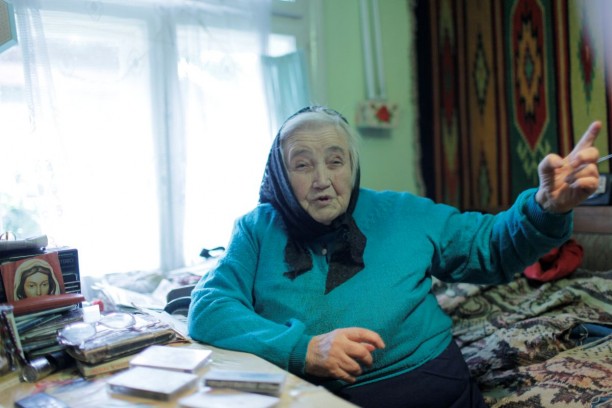
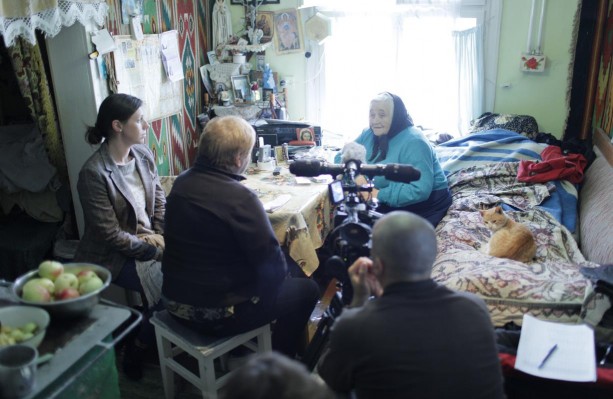
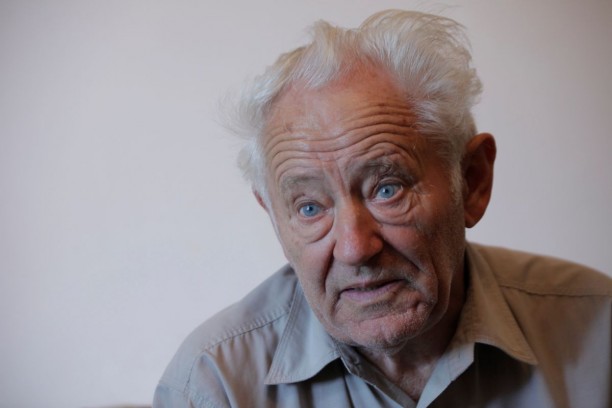
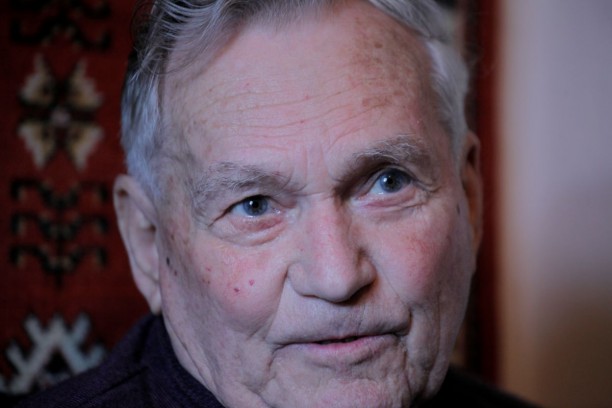
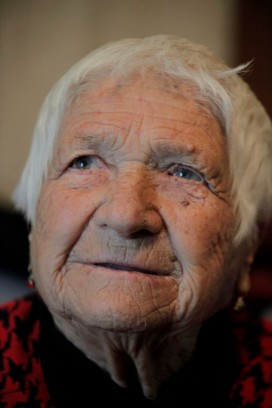
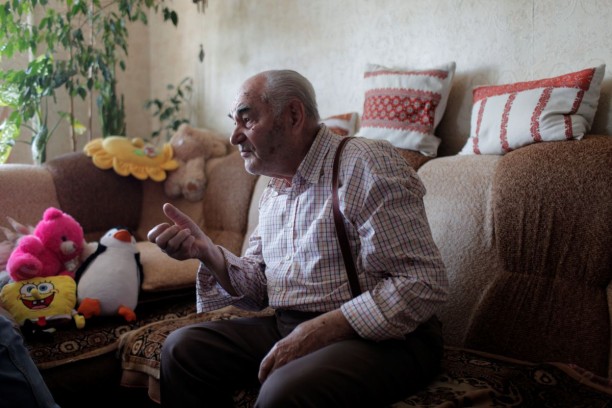
Volodymyr P., born in 1932: "It was in 1942. I was on my way to visit my family in Kalush when I saw about 50 Jews being taken to the Jewish cemetery by guards wearing black uniforms. I was around 300 meters away. Because the cemetery fence was blocking my view, I climbed onto a haystack with some other children to see what was happening.
From there, I saw two men take machine guns from a cart parked nearby and begin shooting. The victims were not forced to undress; I believe they were simply lined up at the edge of the pit. Toward the end of the shooting, I heard children screaming from inside the pit. The two men walked along the edge, firing additional shots downward to make sure no one was left alive.
When the screaming stopped, the two shooters threw their gloves into the pit, climbed back onto their cart, and drove away. I cannot say for certain whether they were Germans; I only know that they were the ones in charge and that their role was to maintain order.
The undertaker, who lived across from the cemetery and was responsible for its upkeep, must have filled in the pit afterward." (Testimony N°YIU2112U, interviewed in Ivano-Frankivsk, on June 18, 2016)
"[…] Between August 23 and 25, 1941, an Aktion was carried out in Kalush. A group of Gestapo officers arrived from Stanislavov [today Ivano-Frankivsk], led by the local Gestapo chief, Kriger [Krüger]. Supported by their accomplices, the Ukrainian policemen of Kalush […], they rounded up most of the town’s wealthy Jewish residents and members of the Jewish intelligentsia. Among them were: 1. Dr. Pemlikh, 2. Dr. Guefel, 3. Lawyer Finkelshtein, 4. Lawyer Sokal, 5. Engineer Finkel, 6. Schoolteacher Shpats, 7. Dr. Vasserman, 8. Dr. Aizenbroukh, 9. Lawyer Nadel, 10. Schoolteacher Chtraoussova, and many others, along with their families, totaling 380 people. After being systematically looted, beaten, and subjected to further humiliations, all the 380 people were loaded into trucks, barely clothed, and driven toward a pre-dug pit. This pit was located 3 km from the town in a forest below the railway tracks, near the village of Piilo in the Kalush district, at a site known as "Berezina." There, they were all executed by firing squad." [Act N°1 drawn by State Extraordinary Soviet Commission (ChGK), on May 14, 1945; GARF 7021-73-08, p.8/Copy USHMM RG.22-002M]
"[…] In November 1942, on the orders of the head of the Gestapo in Stanislavov, Kriguer [Krüger], and with his direct participation as well as that of the Ukrainian police […], roundups lasting three days took place in the town of Kalush. Approximately 3,000 civilians were arrested at that time. They were all loaded onto a special train and taken to the town of Beltsy [Bełżec], where they were exterminated." [Act N°2 drawn by State Extraordinary Soviet Commission (ChGK), on May 14, 1945; GARF 7021-73-08, p.6/Copy USHMM RG.22-002M]
"From August 1941 to December 1943, on the orders of the Gestapo, the Ukrainian-German police and the criminal police ‘Kripo’ […], with the assistance of the labor exchange, the so-called Arbeitsamt […], detained and subsequently murdered 1,500 civilians as a result of individual and, often, mass killings, arbitrary executions, as well as death from starvation and abuse, which occurred within the ‘ghetto’ and, in particular, in the criminal police headquarters. The following examples may be cited:
– The population detained in the ‘ghetto’ and in the ‘Kripo’ received 100–150 grams of bread and ½ liter of [illegible: coffee?/gruel?] per day. It was forbidden to buy food at the market, or even to go there, and those who did were shot. As a result, people became swollen and died of starvation. However, most of them were finished off in the ‘Kripo,’ which called the hospital each day to take away and bury 10–15 bodies per day.
– Persons who went outside after 8 o’clock in the evening, as well as those who walked on the sidewalk, especially persons of Jewish nationality, were also shot without trial.
– At the beginning of May 1942, the ‘Kripo’ took 50 people swollen from hunger from the ghetto and shot them at the Jewish cemetery. This was repeated on May 20 and May 22, 1942: 100 people were shot at the Jewish cemetery. Similar massacres, with varying numbers of victims, took place throughout [the occupation] until the total extermination of citizens of Jewish nationality." [Act N°6 drawn by State Extraordinary Soviet Commission (ChGK), on May 12, 1945; GARF 7021-73-08, p.10/Copy USHMM RG.22-002M]
"The liquidation of the ghetto took place in December 1942, after several small Aktions in October and November of that year, during which the elderly people and the people who couldn’t work were shot." [Deposition of Anna R., November 2, 1954; B162-4996]
Kalush is located approximately 27 km (17 mi) north-northwest of Ivano-Frankivsk. Jewish settlement in Kalush dates back to the mid-16th century. By the 19th century, the community had become a cornerstone of the local economy, notably through the leasing of salt mines and participation in regional trade in grain, timber, textiles, and hides. According to the 1910 census, Kalush was home to 4,363 Jewish residents, representing roughly 50 percent of the town’s total population.
After the First World War, Kalush was incorporated into the Second Polish Republic as part of Eastern Galicia. During the interwar period, most Jews were engaged in small-scale commerce and craftsmanship, although a professional class of Jewish doctors and lawyers also developed. Communal life was vibrant and diverse, encompassing Zionist youth movements as well as non-Zionist organizations, welfare societies, a Talmud Torah, and a Tarbut school where Hebrew served as the principal language of instruction.
In 1931, 3,967 Jews were recorded as residing in the town.
Following the Molotov–Ribbentrop Pact of 1939, Kalush was annexed into Soviet Ukraine. Under Soviet rule, independent Jewish political and communal activities were prohibited.
On the eve of the German invasion, the Jewish population numbered approximately 5,000. By July 1941, this figure is estimated to have risen to around 6,000, likely due in part to the arrival of Jewish refugees from western Poland.
Kalush was first occupied by Hungarian troops on July 6, 1941, before coming under German control within the following two weeks. After a brief period of military administration, German civil authorities assumed control of the town on August 1, 1941. Anti-Jewish Aktionen began shortly thereafter. These operations were carried out by the Security Police outpost of Stanisławów (today Ivano-Frankivsk), together with the German Criminal Police (Kripo), the German Gendarmerie, and Ukrainian auxiliary police stationed in Kalush.
During the summer of 1941, anti-Jewish decrees were introduced, including the compulsory wearing of distinctive signs, restrictions on movement, forced labor, and the confiscation of Jewish property. A Judenrat (Jewish Council) was established to implement German directives, assisted by a Jewish police force. At the same time, Jews from surrounding villages began arriving in Kalush, seeking refuge from violence carried out by Ukrainian nationalist groups.
Between August 23 and 25, 1941, approximately 380 members of the Jewish intelligentsia and wealthy merchants were arrested by a detachment of the Security Police from Stanisławów, with the assistance of Ukrainian policemen. After being held at the local police station, they were transported about 3 km to the Pójło (Piilo) forest, where they were shot and buried.
On September 25, 1941, an additional 50 Jews were shot by the Gendarmerie near the road linking the former German colony of Ugartsthal (today Sivka-Kaluska) and the village of Kropyvnyk.
At the end of 1941, an open ghetto was established in the Jewish quarter of Kalush. By April 1942, it confined approximately 6,300 Jews, including local residents and Jews from nearby settlements. Ghetto inhabitants were subjected to forced labor in agriculture, sawmills, workshops, and for German firms. In April 1942, around 800 ghetto inmates deemed unfit for work were shot by the Security Police from Stanisławów.
Overcrowding, hunger, disease, and repeated killings led to the deaths of many ghetto residents, whose bodies were buried in the local Jewish cemetery. Beginning in May 1942, additional mass shootings were carried out at the cemetery. Yahad witnesses Volodymyr P., born in 1932, and Maria S., born in 1929, both testified to having seen the shooting of approximately 50 Jews there in 1942.
In August 1942, more than 200 Jewish families were forcibly transferred to the Kalush ghetto from the Rożniatów subdistrict and neighboring villages, including Perehinske, Uhryniv, Yaseniv, Sivka, Yasen, Zaviy, Berlohy, Petriv, Novytsia, Grabivka, and Kamin. Following this concentration of the Jewish population, the Security Police unit from Stanisławów carried out several Aktionen in the autumn of 1942. During these operations, some Jews were transferred to Stanisławów and killed there, while others were deported to the Bełżec extermination camp.
The final major Aktion appears to have taken place either in September or November 1942, according to differing accounts, during which approximately 3,000 Jews were deported to Bełżec. Some Jews who had gone into hiding during these deportations later emerged and were subsequently transferred to Stanisławów, after which the town was declared “free of Jews.”
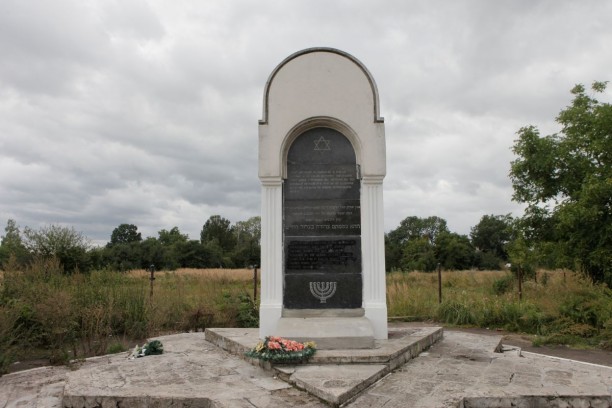
Today, a monument stands at the Jewish cemetery in Kalush commemorating approximately 6,000 Jews murdered by the Germans in the Kalush region between 1941 and 1944. The precise number of victims buried at the cemetery site, however, remains uncertain and may range from several hundred to several thousand.
For further information on the murder of Jews from Kalush in Sivka-Kaluska, please refer to the corresponding profiles.
Do you have additional information regarding a village that you would like to share with Yahad ?
Please contact us at contact@yahadinunum.org
or by calling Yahad – In Unum at +33 (0) 1 53 20 13 17